The Premier Portable Office
For anyone drawn to the ancient rhythms of Benedictine prayer, finding a prayer book that is both comprehensive and portable can be a challenge. The Monastic Diurnal, published by St. Michael’s Abbey Press, stands out as one of the finest single-volume breviaries available today.
Containing all the daytime hours of the traditional 1963 Benedictine Divine Office—omitting only the office of Matins (think office of readings) —this volume serves as a complete liturgical library in a surprisingly compact form factor. Whether you are a Benedictine oblate, a traveler visiting monasteries like Clear Creek or simply looking to deepen your personal prayer life, this book is built specifically for the task – especially if you want Latin and English side-by-side.

If you wish to purchase this book, please consider visiting our friends at Praying Latin.
Use the coupon code “LordMakeHaste” for 10% off!
We will gain a small commission that helps support the mission of Lord Make Haste.
If you’re not familiar with Praying Latin, they’re one of my favorite stores and are probably one of yours as well if you’re a Divine Office fan. Their website explains their mission…
Because we love the Catholic faith and tradition, and we firmly believe that Catholics need access to reverent, beautiful, otherworldly prayer now more than ever. The end goal of all our work is the salvation of souls for the glory of God, and this time-tested sacred tradition of prayer continues to unite and bring souls to God today just as it has nourished and produced the greatest Saints throughout the centuries.
What is a Diurnal?
First of all, a Diurnal means that the breviary contains the day hours. That incldues Prime, Lauds, Terce, Sext, None, Vespers and Compline. What that omits is what we might call Matins or Vigils – its parallel would be the Office of Readings. Including that would make the book much larger.
Prime comes from the first hour of daylight, or as St Benedict would have called it, “primae tempore” or “the time of First Hour” essentially. The history of prime is, in and of itself, a fascinating history worth its own post. It does not have a close parelle in the Liturgy of the Hours you might be used to.
Lauds is simply Morning prayer and Vespers is Evening prayer, your “hinge hours” as they are popularly called. Lauds orginally refereed to the laudate psalms but came to refer to this office.
Terce, Sext and None are your daytime hours and their Latin names simply refer to when they should be prayed (third hour, noon, and ninth hour).
Compline is what you may know already as night prayer. The Benedictine office is set apart from the Liturgy of the Hours in a unique way, but many find Compline to be exceptionally beautiful in the monastic tradition.
Publisher
The first several editions were actually produced by Saint John’s Abbey in Collegeville, MN. This book is currently published by Saint Michael’s Abbey Press, located on the grounds of Saint Michael’s Abbey in Farnborough, England.

While this book is a republication of the 1963 edition of the Benedcitine daytime hours, St Michael’s Abbey Press is also known for their printing of the 1962 Marietti Brevarium Monasticum. That two volume set – likely the topic of a future post – is laid out in a similar manner to this single book.
Physical Quality & Binding
As a physical object, the Monastic Diurnal is crafted to withstand daily, lifelong use.
- Binding & Leather: Wrapped in genuine Moroccan leather with a flexible cover, the book feels premium and supple in the hands right out of the box. The cover features a subtle stamped image of the St. Benedict medal on the front. The back of the book shows the backside of the St. Benedict medal as well. It is impossible to overstate it; this book just feels absolutely wonderful in the hand.
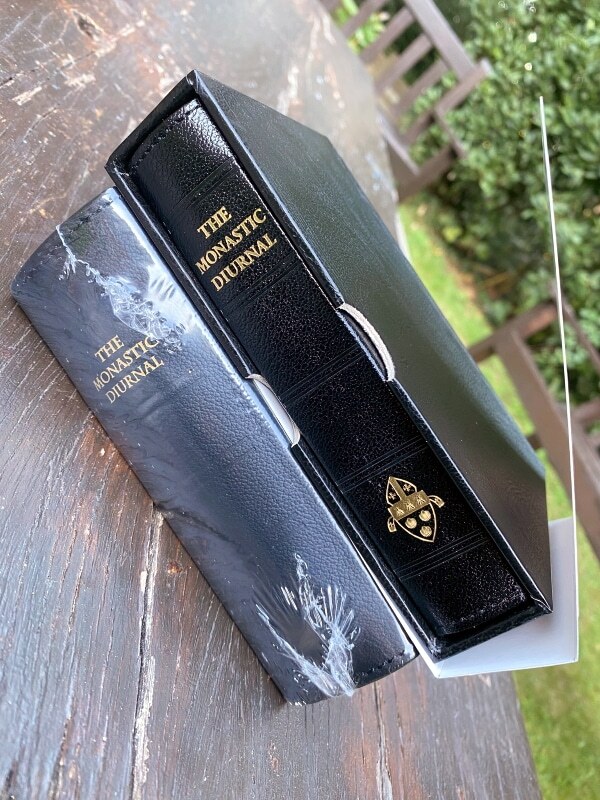
- Paper & Thickness: The recent 8th edition utilizes a thinner, high-grade prayer book paper that significantly reduces overall bulk while minimizing bleed-through. The entire 1,480-page volume is noticably thinner than the previous 7th edition, but is otherwise unchanged
The photo provided by the publisher shows the difference between the two editions. Even with a protective box, the 8th edition is significantly thinner.

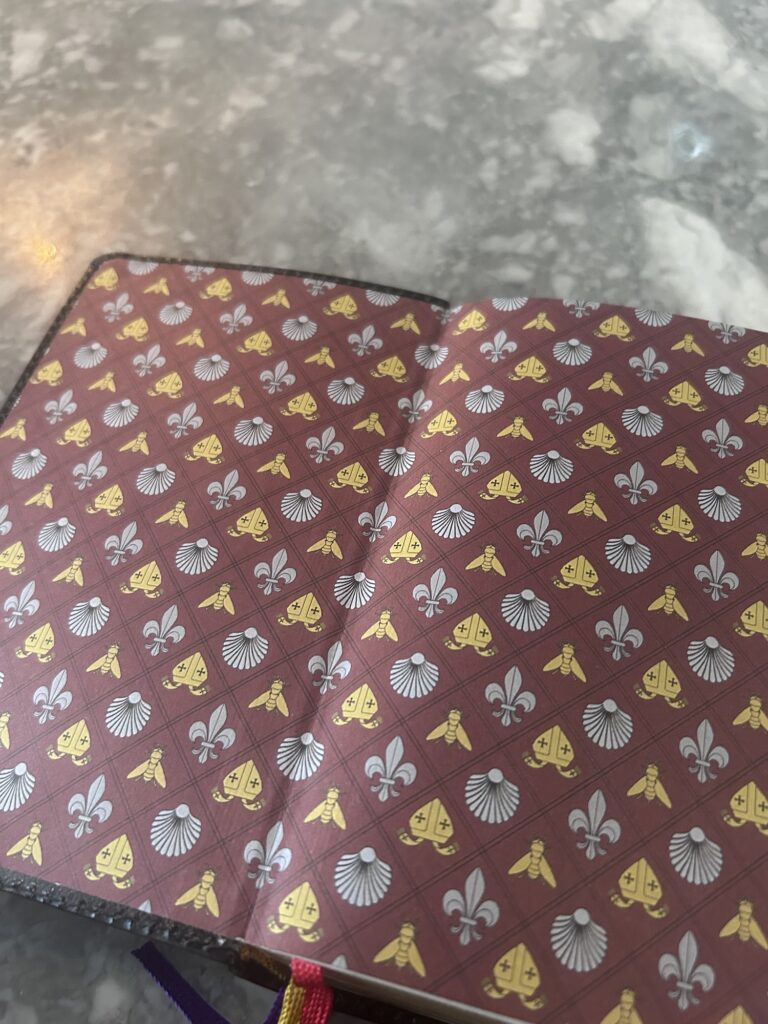
- Page Edges & Extras: The pages of this book feature gilt edges that are simple and stunning, with almost no “stickiness” between the pages. The simple black cover gives off a very simple Benedictine vibe, but the gilded page edges just give it an extra feeling of beautify and value. It also features decorative endpapers; and the book ships with a matching protective slipcase to prevent page damage inside bags.
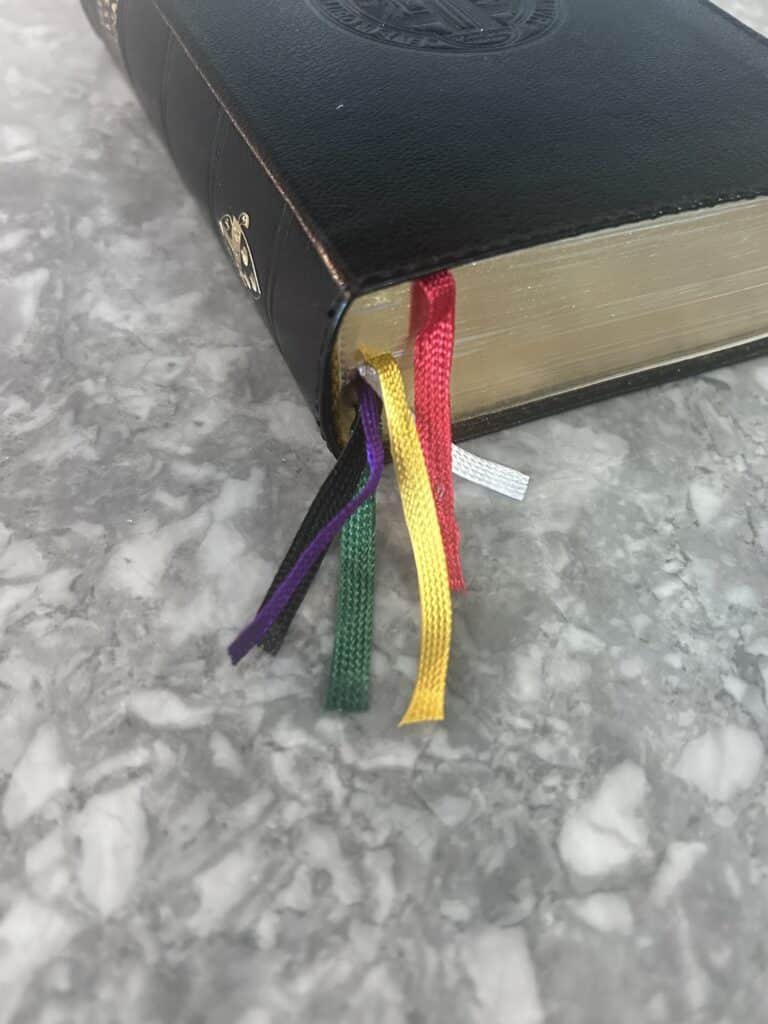
The Ribbons: It comes with six ribbon markers—an absolute necessity for navigating the complex breviary layout. They’re pretty good but not the best you’ll ever encounter.
Note on durability: The ribbon ends can fray over time. They are not the type of ribbon that you can take a lighter to and expect a clean, crisp end. Instead, many people recommend adding craft glue or even clear fingernail polish.
In my experience, a product made for this such is much better; I do wish they shipped this way but it is a minor ugprade to protect your investment.
You can find Dritz Fray Check on Amazon; Lord Make Haste will make a small commission from your purchase.

Layout & Typography Inside
The interior layout is where this edition truly shines in terms of legibility and traditional craftsmanship:
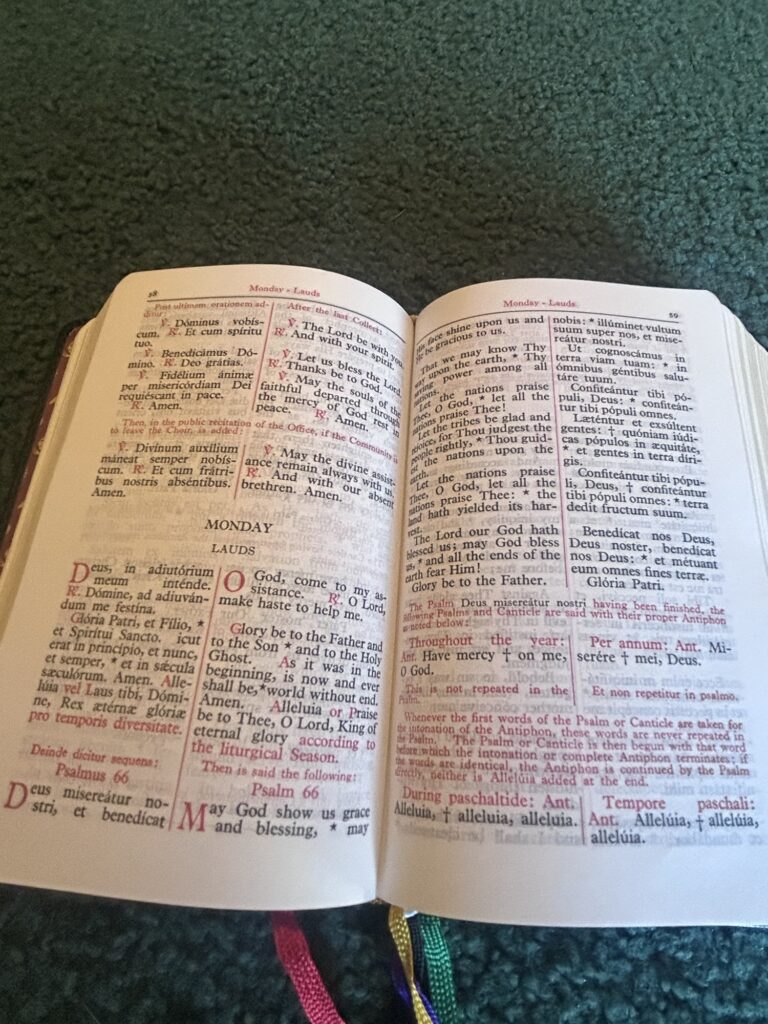
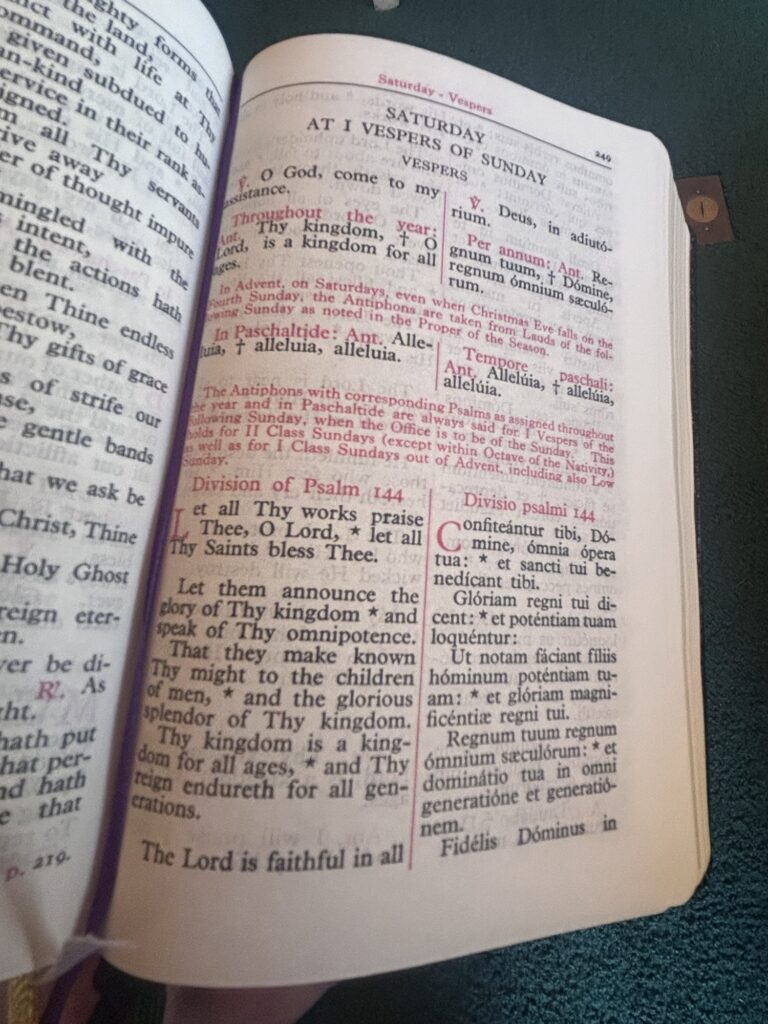
- Two-Color Rubrics: Printed entirely in crisp red and black ink. The red rubrics guide your movements and responses, while the black text contains the prayers and psalms.
- Side-by-Side Latin and English: Text is set in parallel columns. One column contains the traditional Latin Vulgate, while the right offers a faithful, elevated English translation. This layout makes it effortless to pray in either language or to use the English as a quick reference while learning Latin.
- Typeface & Readability: Despite the book’s small footprint, the font choice is clear, dark, and easy on the eyes, even in lower light (such as early morning Lauds or late night Compline). There is some bleed through on the pages, but not more than is to be expected.
If there are any negatives one can point out to the layout, they are twofold.
- Columns – The Latin-English layout is not something like “Latin on the left, English on the right” but rather has the Latin in the outer column and the English on the inner column. I personally have gotten quite used to this, but it is a bit counterintuitive at first.
- Gutter – This might be related to the above. But this book can display its text quite deep into the gutter. If you’re primarily praying the Latin (in the outer column) that is a non-issue. Luckily, the book lays flat effortlessly and this is the cost of having a small, portable book. But, it is worth considering.
Can we interrupt you for a second to ask for your support?
Consider supporting Lord Make Haste if you find this content worthwhile. We are a 501(c)3 nonprofit lay apostolate; we appreciate any support you can provide.
Another way to support us is by shopping through our affiliates links.
Amazon | The Catholic Company | Word on Fire | TAN Books | Ignatius Press | Catholic Coffee
Navigation & Practical Usability
Navigating a traditional 1963 breviary requires a short learning curve, but the diurnal’s structure keeps things logical. The volume is split into logical and distinct sections:
Instruction – There is a preface that features instructions and includes an explanation into the relatively complex arrangement of feasts in the Benedictine tradition. It also includes a calendar – the 8th edition calendar extends to 2051.
Proper of Seasons – Just as you would expect from any breviary. Although, the Benedictine calendar won’t line up perfectly with what you’re used to, particularly if you attend a Novus Ordo mass in the United States.
Specific Hours – From there, it contains each specific hour. Keep in mind that St. Benedict set up a one-week rotation – not a four-week rotation like we see in the Liturgy of the Hours. So, you’ve got Monday Lauds for example, no “Monday Week IV Lauds” situation.
Commons – Similar to other breviaries, you get a commons section. And yes, it does include the Office of the Dead.
Other Sections – There are some other helpful things at the back, including an index.
Chat Sheets – The book comes with a heavy cardstock Benedictus and Magnificat canticle cheat sheet. It also has a very helpful little sheet that serves as a quick reference for ribbon setting.
The Good and Bad
The Strengths
- The Seven Day Hours: Full texts for Prime, Lauds, Terce, Sext, None, Vespers, and Compline.
- Special Devotions: Includes the full Office of the Dead (which does include Matins), the Penitential Psalms & Litany, and the Itinerary (travel prayers).
- Liturgical Consistency: Fully aligned with the 1962 Roman calendar used in traditional Latin Mass communities.
- Latin: This is a great way to learn Latin!
The Limitations
- No Matins: Because it is a diurnal, the standard daily Matins (Office of Readings/Vigils) is omitted to keep the book portable. If you need Matins, you would need a companion volume – we have plans to cover your options here in an upcoming post.
- Initial Complexity: First-time breviary users may feel overwhelmed by managing multiple ribbons across the five sections, though a few days of practice quickly builds muscle memory and there are great online resources.
Final Verdict
The St. Michael’s Abbey Press Monastic Diurnal is a masterclass in liturgical publishing. It balances durability, aesthetic beauty, and compact portability without sacrificing text size, readability, or affordability.
Blogs and Youtube videos do not even come close to doing this book justice. You have just got to pick it up and feel it in your hand.
For anyone seeking a traditional, dual-language edition of the Benedictine Office, this book is worth every penny. It is not just a reference book for the shelf, but a daily companion designed to endure decades of constant prayer.
Curious – if you pray or have prayed the Monastic Diurnal, how long did it take you to get used to it and what resources did you use?
-

Monastic Diurnal by Saint Michael’s Abbey Press
The Premier Portable Office For anyone drawn to the ancient rhythms of Benedictine prayer, finding…
-
Major Extracts Publishers: An Early Look
If you’ve been following the news around the upcoming Liturgy of the Hours, Second Edition,…
-
Second Edition of the Liturgy of the Hours
Academic Paper If you’re a real Liturgy of the Hours nerd… like the kind that…

Leave a Reply